Tuesday, May 10, 2016

recycled art: an unconventional way to reduce waste


Recycled Art

We live in the time of K-cups and plastic bags—a use-it-once mentality. Most people don’t think twice before throwing away their Starbucks coffee cup and once it enters the bin, its fate becomes a mystery. However, readers of this U-M Recycling blog have most likely thought about their waste. You’ve wondered if something was compostable or suggested to a friend that they should recycle that newspaper, but have you ever imagined that what you throw in the bin could take on a new life, before it hits the trash pile? Artists across the world are reimagining lives for the things we commonly throw away. It’s called recycled art. 

The artists behind recycled art take the items we throw away and turn them into something entirely new. These materials connect us to the artwork and prompt us to consider our own waste. While these exceptional creations may be unconventional, we can look to them and ask ourselves how we reduce waste in our own lives.

What came first?

Kyle Bean

Kyle Bean is a London artist who uses everyday objects to create his pieces. The image below he has constructed a chicken made from the eggshells that we all find in our kitchen waste. [1] If you can compost, then throw your egg shells into the compost bin!



Corner Forest

Yuken Teruya

Based in New York, Yuken Teruya creates artwork inspired by his life in Japan. In his project, Corner Forest, he uses toilet paper rolls to create a forest that appears to be suspended in the air. He describes his role in the piece as “...helping the paper awakens its ability to come to life.”[2]

While you might not transform your toilet paper rolls into artwork, you can extend their usefulness by putting them in the recycling bin!


Tim Noble and Sue Webster

Real Life is Rubbish 

These two British artists use an assortment of items commonly thrown away to assemble sculptures that cast shadows. These shadows create highly accurate profiles of the artists. In this piece, Real Life is Rubbish, 2002, you can find metal and wood scraps, cans, and toilet paper rolls incorporated into the sculpture in addition to countless other items that come from the waste bin.[3]


Blowing Bubbles


Derek Gores

This New York Artist recycles magazines, labels, and digital materials by creating elaborate collage portraits.[4]


We all remember making a magazine and newspaper collage in grade school. You can recycle your college reading materials at UMICH if you don’t think you’re up for another round of cut and paste!


Iri5 (“Iris”)

This Chicago based artist recycles cassette tapes to create her unique portraits. [5]

While we may not have old cassette tapes lying around anymore, electronic waste is quickly filling up landfill space and may contain potentially hazardous materials. Dispose of your e-Waste responsibly at the annual free e-Waste Recycling Event hosted by the University of Michigan’s Office of Campus Sustainability each spring!


References

[1]  Bean, K. (n.d.). Kyle Bean. Retrieved May 10, 2016, from https://kylebean.co.uk/aboutRecycled Art
[2]  Teruya, Y. (2003-2009). Corner Forest. Retrieved May 10, 2016, from http://www.yukenteruyastudio.com/projects-1/coner-forest 
[3]  Noble, T., & Webster, S. (2002). Real Life is Rubbish. Retrieved May 10, 2016, from http://www.timnobleandsuewebster.com/real_life_is_rubbish_2002.html
[4]  Gores, D. (n.d.). Commissions/Clients. Retrieved May 10, 2016, from http://derekgores.com/about
[5]  Simmons, E. I. (n.d.). Iri5. Retrieved May 10, 2016, from http://iri5.com/the-artist/


Thursday, April 7, 2016

11 fun facts you may not know about Waste Reduction and Recycling at U-M!

Because who doesn't want to learn 11 new things about Waste Reduction and Recycling at their awesome school?

1. (Almost) All dining halls send pre- and post-consumer waste to be turned into compost. We have pre-consumer composting at all dining halls, the Union, the League, Pierpont Commons, Palmer Commons, and Mujo Cafe. Post-consumer composting is being practiced at East Quad, South Quad, North Quad, and Bursley. This means that when you have a meal at East Quad with friends, your food scraps are composted! Michigan Dining is also working toward post-consumer composting at the rest of their locations!  Just in case you don't know, here are our definitions of pre- and post- consumer waste:
Pre-consumer waste: Material that is discarded before it is ready for consumer use. For example, if a restaurant prepares a fruit salad with an orange in it, the orange peel would be an example of pre-consumer waste.
Post-consumer waste: Material that is discarded after it has been given to the consumer. For example, if you go to Sava's and don't finish your meal (an act which I don't personally see as a possibility at Sava's) the remainder of your meal is compostable, post-consumer waste.


2. Our compostable waste here at U-M is sent to WeCare Organics, who operate the City of Ann Arbor's compost site. At WeCare, our food scraps are formed into long piles called windrows, and begins to aerobically compost. Compost from this site is then sold to farmers, landscapers, and homeowners. Pretty cool, huh? To read more about composting at the University, read our composting post or check out our webpage on composting

3. Any of your student groups' events can be zero waste (have exclusively composting and recycling, no trash). Find out how to make your student group's next event Zero Waste through the Student Sustainability Initiative's Zero Waste event program. Learn more about zero waste here at U-M from our composting post.


Cooking sheets are recyclable on campus!
4. You can recycle old cooking sheets in any recycling bin or dumpster on campus. You can also recycle your brown bag from Panera, Chipotle, or Noodles & Company in any on-campus recycling bin. Milk cartons and Soy milk boxes are also recyclable on-campus. Paper towel rolls and post-it notes are also recyclable here on campus! Staples and paperclips are okay to go in the recycling bins on campus as well. 

5. The Rufus you see on campus isn't the original Rufus. Can you spot the differences in the photos below? The original Rufus is in the photo on the left, and the most recent Rufus is in the photo on the right.


6. Speaking of Rufus, he has a Facebook, a Twitter, and an Instagram account (@rufustherecycler). Follow him now for free recycling and waste reduction tips, giveaways, and event invites!
7. You can recycle your old batteries at the Fishbowl. You cannot place old batteries into an on-campus trash or recycling bin. Improperly disposing of batteries can lead to the leaching of poisonous chemicals and acids into our groundwater. Visit this page to learn more.
8. Glass recycling has been temporarily suspended on campus. The reason for this suspension is the lack of a sufficient market for recycled glass containers. Prior to the suspension, glass recycling accounted for less than 1% of the total recycled waste produced by U-M. To learn more about the glass recycling suspension, click here.
9. All recyclables you place in an on-campus recycling bin go to the Western Washtenaw Recycling Authority. To read more about the journey your recyclables take after you put them in a bin, read our "Where does my recycling go?" post.

10.  Plastic bottle caps (depicted to the right) aren't recyclable through any old recycling bin on campus. The Waste Reduction and Recycling Office just launched a pilot program, Cap-Ture, to collect and recycling plastic and metal bottle caps. With the help of Terracycle, these caps will be recycled into new products. You can collect and send your plastic bottle caps to us via campus mail: Cap-Ture, 109 E. Madison St. campus zip 2943. Want to know more about Cap-ture? Visit our website.
11. You can recycle any electronic waste (old phones, speakers, wires and cables, etc.) at our annual E-Waste Recycling Event! This event is open to the public on Saturday, May 7th, 2016 from 9 a.m. to 2 p.m. in the Pioneer High School Parking Lot. This event is coordinated/sponsored by the Office of Campus Sustainability (OCS), and questions regarding the event should be directed toward OCS.   

That's all, folks! We hope you learned something new. As always, please direct any questions to recycle@umich.edu. 

Tuesday, February 16, 2016

Where does my recycling go?

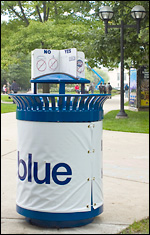
A recycling bin on the
University of Michigan's Diag.
University of Michigan students, staff, and faculty recycle over 2,500 tons of materials each year. Do you ever wonder what happens to your plastic bottle, aluminum can, or piece of printer paper when you put it in that beautiful blue bin? The University of Michigan Waste Reduction and Recycling Office is here to tell you step by step what happens to your recyclables after you've put them in the recycling bin. 
Step 1: You put an item into a recycling bin on campus, such as the recycling bin depicted to the right. 
Step 2: Once full, a member of the custodial staff dumps the contents of that recycling bin into a blue bag of other recyclables. 
A blue University of
Michigan recycling dumpster.
Step 3: The member of the custodial staff places the blue bag of recyclables into that building's blue recycling dumpster (depicted to the left). Typically, any campus building has both a recycling and trash dumpster. Some buildings will share a dumpster with others due to their smaller recycling output, while others will have additional dumpsters because of their larger size. For example, Michigan Stadium has four recycling dumpsters. 

U-M Recycling Trucks
Two Waste Management Services recycling trucks.


Step 4: A Plant Operations truck will come and load the contents of the recycling dumpster into their truck (depicted to the right). Most buildings have their recycling dumpsters emptied on a regular schedule, for example a Monday, Wednesday, and Friday cycle. Some smaller buildings call in to have their dumpsters emptied. Waste Management Services' truck drivers also pick up trash, compost, Styrofoam, wood, metal—except for regulated waste (such as batteries or electronics which are handled by OSEH).
Step 5: The Plant Operations truck will drop off your recyclables at the Western Washtenaw Recycling Authority. As of October of 2015, the University of Michigan's recyclables are going to the Western Washtenaw Recycling Authority in Chelsea, MI. Previously, our recyclables were going to the Materials Recovery Facility in Ann Arbor.
Truck at WWRA facility
A photo of the Western
Washtenaw Recycling Authority.
Step 6: Your recyclables are sorted according to their material makeup at the Western Washtenaw Recycling Authority. If you throw something away that isn't accepted as recyclable at the WWRA, it will be sorted as trash.
Step 7: Your recyclables, along with other objects of the same material, will be compressed into cubes.
Step 8: The bales of recyclables are picked up by various companies and organizations to use in the creation of new products!


References
"Home." Western Washtenaw Recycling Authority. Western Washtenaw Recycling Authority, n.d. Web. 14 Feb. 2016.
"PBA Spotlight." Sustainability.umich.edu. Graham Sustainability Institute, Sept. 2014. Web. 14 Feb. 2016.

Tuesday, January 5, 2016

New Year's Waste Reduction Resolutions


Today is the day to discuss the inevitable: New Year's Resolutions. We've all had them. The majority of us have set fitness goals, professional goals, diet goals, etc. on this day. Many people set waist reduction goals, but today we're talking about WASTE reduction resolutions. If you're reading this blog, it is likely that you aim to be an environmentally conscious citizen. One of the best ways to realize your true potential as a conscious citizen is to set goals for environmentally friendly behaviors and follow them. So, we've compiled a list of a few goals you can and should set for yourself for 2016.

Super Easy Resolutions
  1. Bring and use reusable bags whenever you go grocery shopping. This is an easy one. If you don't have any reusable bags, buy some the next time you grocery shop. They have them at virtually every store these days. If you always forget to grab them when you're leaving your house, go put them in your car right now. If you always forget them when you're going from your car to the store, set a reminder on your phone to tell you to grab them from your car. Or better yet, put the bags right in the front seat so they are directly in your line of vision.
  2. Avoid individually packaged goods - go for larger containers of your favorite goods. For example, purchase a quart of yogurt rather than a number of individual packages of yogurt. Aim to buy a box of cereal rather than individual servings of cereal in small boxes. Larger amounts of food stored in one package amounts to less packaging waste than a number of servings that are individually packaged.
  3. Buy paper products made of post-consumer recycled content. The next time you need a new notebook, or a blue book for an exam, or even a box for moving, buy the recycled version. This is like voting with your dollar - by purchasing these products you are telling producers of recycled products that you support their business.
Bit-of-a-Challenge Resolutions

  1. Reduce the amount of times you eat out per week by 2-4 times. In particular, take out and fast food products involve lots of un-recyclable packaging materials. Eating at home rather than at one of these places will produce less waste. 
  2. Recycle your plastic bags at the grocery store. We all have a giant stock of plastic grocery bags at home. Save a few to use as small trash can bags and doggie bags and take the rest to your local grocer to recycle them. Meijer typically has a small plastic bag recycling stand just inside the entrance.
  3. Cancel your subscriptions to magazines and catalogs you no longer read. According to Rethink Recycling, the average resident in America receives over 30 pounds of junk mail per year. While you can recycle that paper, it would be less wasteful if that magazine/catalog never got printed.
Full Fledged Commitment Resolutions

  1.  
  2. Compost your food scraps at home. If you live in a UMich dorm, chances are your dining hall already composts your food waste before and after serving it to you. However, if you live off-campus, click here to learn about how you can compost through the City of Ann Arbor.
  3. Go paperless. Don't print anything - emails, readings for classes, reports for work. Get accustomed to reading from a computer, tablet, or phone. Recycling paper is great, but it also takes energy to produce and print paper - energy use that could be avoided.
  4. Stop consuming plastic Ziploc bags. Switch from use of plastic sandwich bags to reusable tupperware. Often we put our snacks and sandwiches in these plastic Ziploc bags, when tupperware are just as handy and better protect your food when it is bouncing around your backpack or purse.
References
"Top 10 Ways to Reduce Waste." Rethink Recycling. N.p., n.d. Web. 30 Dec. 2015.


Sunday, November 15, 2015

Law orders use of disposable dishes at restaurants?!

If you are a person, you may have heard that California is currently facing one of its most severe droughts on record. In fact, it is entering its fourth year of this devastating drought. Governor Jerry Brown has imposed strict conservation measures statewide, including 35% reductions in the water use of private residences and increasing fines for "water wasters." Brown lawns, rather than pristine green lawns, have become the new socially acceptable norm. 
This photo was retrieved here.
However, you're reading a blog post from the Waste Reduction and Recycling Office. What does the drought have to do with waste reduction or recycling? Well, as a result of the drought, the city of Fort Bragg, CA, has ordered restaurants to use disposable plates, cups, and silverware to cut down on water use from dishwashing, and to only serve water to customers when asked.
This photo was retrieved here.
Businesses and residents alike have been mandated to reduce water use by 30%. City Council has, naturally, received harsh criticism from residents, and is going to re-review the order shortly. The critical issue this order brings to the surface is that there is a clear trade-off between eliminating waste by using China, or eliminating water use by providing disposable dishware. Which is worse for the natural environment? The answer would be extremely difficult to determine. Is this a cost-effective way to reduce water use? Jim Hurst, the co-owner of Silvers at the Wharf and Point Noyo Restaurant and Bar, said he expects the "expense is going to be horrendous." Another aspect of this debacle to consider is customer experience. People go out to dinner to have a special night, possibly even to celebrate an already special occasion. Plastic plates and silverware could kill a mood quickly, and restaurants across the city will suffer. Not to mention Fort Bragg's economy, being located directly on California's Pacific Coast, is based largely on tourism. At the end of the day, however, a significant amount of water would be saved if all of the restaurants in a city stopped washing dishes. Is it worth the cost to restaurants and customers alike? We'll have to wait for Fort Braggs to decide.


References
Booker, Brakkton. "California City Orders Restaurants To Use Disposable Plates, 
     Cups." NPR. NPR, 7 Oct. 2015. Web. 25 Oct. 2015.
Tufano, Linda. "California City Orders Restaurants to Use Disposable Plates, Cups." Latest 
     News8 Oct. 2015. Web. 18 Oct. 2015.

Wednesday, June 10, 2015

New Recycling Labels

Ever glanced at a product or its packaging and noticed one of the symbols seen on the right? Did you think that, because the symbol is the three chasing arrows, the material was recyclable? Unfortunately, this is not necessarily the case. These symbols are called Resin Identification Codes (RICs), and details are highlighted in the photo below. RICs were developed by The Society of the Plastics Industry (SPI) in 1988 and are now required for use in 39 states. According to How2Recycle, RICs aim to "assist in the identification of resin types for the recycling and plastics industries." In other words, RICs serve the plastics and recycling industries, not necessarily these industries' consumers. The American Society for Testing and Materials states that RICs are not “recycle codes,” do not imply inherent recyclability, and should not be in close proximity to environmental claims (including recyclability). Consumer testing by GreenBlue and other organizations show that the majority of the public does not understand RICs. Consumer interpretations have ranged from a plastics “grade,” popularity, number of times it was recycled, to the presumption that an RIC means something is recyclable. In addition, RICs are not universally found on bags, films, or other product packaging because of varying legislation and interpretations of the guidelines in the photo below.

We've determined that RICs aren't the most effective way to determine if a product is recyclable. How can we label our products so that they do educate consumers about recyclability? How2Recycle is working to answer this question.
The How2Recycle Label
The How2Recycle™ Label is a voluntary, standardized labeling system that clearly communicates recycling instructions to the public. How2Recycle has recently developed a new recycling label to provide consistent and transparent on-package recycling information to consumers. Currently the label only applies to packaging sold in the U.S., with a few select labels available for packaging sold in Canada. The How2Recycle Label is compatible with RICs, however  How2Recycle recommends revamping the RICs "to be more useful to the plastics community while removing the chasing arrows because of confusion surrounding their meaning." 

Widely Recycled
If you see the simple, three chasing arrows on a product, it is safe for you to assume you can recycle it in an on-campus recycling bin or your curbside bin at home. Common examples of these items are cereal boxes, plastic water or soda bottles (but not their caps!), and plastic take-out containers. Double check on a certain item here!
Limited Recycling 
Every area's recycling program is different. Click here to check if it is possible to recycle a certain item in your area. 
Not Yet Recycled
It is likely that this item is not recyclable in your area. Items that are not yet recyclable at the University of Michigan are PVC, styrofoam, and napkins. Double check on a certain item here!
Store Drop-Off
A wide variety of plastic bags, films, and wraps can go in plastic bag recycling bins at your favorite grocery store or retailer. This includes items with the How2Recycle Store Drop-Off label and bags and films using Resin Identification Codes #2 and #4. These items cannot go in to curbside bins. In fact, less than 10% of Americans can put these items in their curbside bin, making store drop-off a great recycling solution. To find out what you can recycle in these bins, and to find recycling locations, click here.

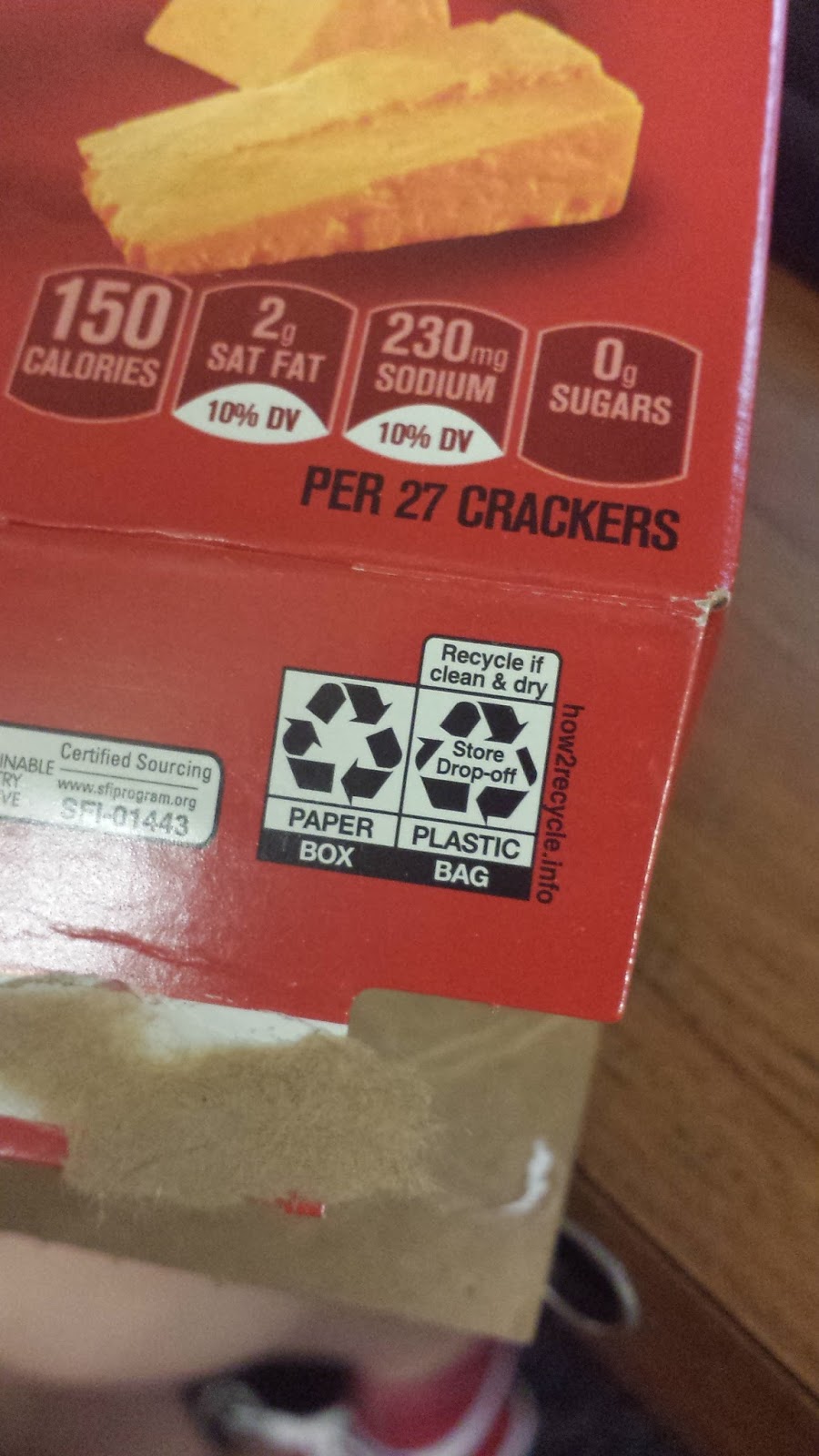
Look out for these new How2Recycle labels, because they are already being printed on packaging! The photo to the right is of a Cheez It box, and it is communicating that the paper box is recyclable, and the plastic bag in which the crackers come is recyclable, if clean and dry, at a local grocery store. You can click here to check which local grocery stores accept these clean & dry plastic bags.

Check out the U-M Waste Reduction and Recycling Office website for more information about what can be recycled on campus and how to recycle uncommon items such as batteries, inkjet cartridges, and hardcover books.

References
"How2Recycle - 2014 Annual Report." How2Recycle (2014): 3-50.How2Recycle.com. Sustainable Packaging Coalition, 2014. Web. 1 June 2015. <http://www.how2recycle.info/wp/wp-content/uploads/2015/04/How2RecycleAnnualReport2014.pdf>.

Friday, May 29, 2015

Are our products designed to create waste?

What do you do with a product when you're done using it? 
On campus, 65.48% of all waste produced is thrown away, to a landfill. Let's consider, for a moment, what a landfill is in the context of a product's life. A landfill is essentially a product graveyard, where all the materials that make up and package our products go to "die." Currently, most products are designed to become obsolete, be disposed of, and be transported out of sight to a landfill. Please refer to Figure 1; the current system through which our products are generated is linear. Products are produced, used, and then disposed of, and the cycle stops there. 
Figure 1


Defining Product Life Cycle Analysis
Figure 2
This method through which we've been looking at a product's life is called a product lifecycle analysis. According to the Renewable Energy Corporation, a product lifecycle analysis (LCA) is "an assessment into the ‘cradle to grave’ environmental impact of a product from the beginnings of its manufacture to its eventual ‘retirement’ or recycling." A number of new approaches to the traditional product lifecycle analysis (shown in Figure 1have emerged. One of which is the life cycle assessed by the Renewable Energy Corporation (seen in Figure 2).We can already see that this is a more closed-loop system, recycling its waste from end-of-use right into the design and creation of a new product. This life cycle, however, still involves the disposal of some waste materials and the incorporation of some new raw materials. It would be ideal if each product were produced in an entirely closed-loop system, with all waste being utilized to generate new products.   

Examining the "Cradle to Cradle" approach
Figure 3
Another alternative approach to the traditional product life cycle is the biomimetic cradle-to-cradle approach. Cradle-to-cradle models human industry on nature's processes, viewing materials as nutrients circulating in sustainable, waste-less cycles. Interested in learning more about cradle-to-cradle? Michael Braungart and William McDonough wrote an entire book on it.

Companies popular on campus are leading the way 

Nike has set up the Nike Reuse-A-Shoe program. The program grinds down used athletic shoes (28 million pairs of shoes have been placed into their shredder box) and turns them into new athletic centers and new products like a Nike jacket. Click here to find a store near campus.


Patagonia is closing the loop with their Ironclad Guarantee; any unsatisfied customer can return a product for repair. Many fraternities on campus purchase gear from Patagonia - next time your fracket tears, send it back for a repair!


Coca-Cola, like Patagonia, is encouraging their customer base to recycle their product. Coke's Reimagine Beverage Containers recycling centers provide interactive collection kiosks which encourage customers to recycle. More than 45 million containers have been recycled since the Reimagine program launched in the Dallas area in late 2010. 


References
"Cradle-to-cradle Design." Wikipedia. Wikimedia Foundation, n.d. Web. 27 May 2015. <http://en.wikipedia.org/wiki/Cradle-to-cradle_design>.

Delivering a Sustainable Railway. London: Stationery Office, 2007. Wind & Sun: Powering the Future. Renewable Energy Corporation. Web. 26 May 2015. <http://www.windandsun.co.uk/media/913/rec-life-cycle-analysis-brochure.pdf>.

"Municipal Solid Waste." EPA. Environmental Protection Agency, n.d. Web. 26 May 2015. <http://www.epa.gov/osw/nonhaz/municipal/>.

"Nike Better World." Nike. Nike, n.d. Web. 26 May 2015. <http%3A%2F%2Fwww.nike.com%2Fus%2Fen_us%2Fc%2Fbetter-world%2Freuse-a-shoe>.

"Patagonia - Repairs, Returns & Recycling." Patagonia - Repairs, Returns & Recycling. Patagonia, n.d. Web. 27 May 2015. <http://www.patagonia.com/us/patagonia.go?assetid=5175>.

Richardson, Alison L. "Building Recycling Rates | Recycling | Plant Operations, UofM." Building Recycling Rates | Recycling | Plant Operations, UofM. Plant Operations at the University of Michigan, 22 Aug. 2014. Web. 27 May 2015. <http://www.plantops.umich.edu/grounds/recycle/building_recycling_rates.php>.